The direct answer is this: FERPA gives students and, in some cases, parents the legal right to access, review, and request corrections to education records held by schools, while also strictly limiting who else can see that information without consent.
It does not give unlimited access to everything a school creates, and it does not apply equally at all ages.
What FERPA Is and Why It Exists
FERPA stands for the Family Educational Rights and Privacy Act, a U.S. federal law enacted in 1974. Its purpose is twofold.
First, it gives students and parents defined rights to access and correct education records. Second, it restricts schools from disclosing personally identifiable student information without permission.
FERPA applies to all educational institutions that receive funding from the U.S. Department of Education, including public K–12 schools, public universities, and most private colleges. If a school accepts federal funds in any form, FERPA applies.
FERPA is enforced by the U.S. Department of Education, specifically through its Student Privacy Policy Office. Schools that violate FERPA risk federal enforcement actions and, in extreme cases, loss of funding.
Who Holds FERPA Rights and When They Transfer
One of the most misunderstood aspects of FERPA is who controls the rights at different stages of education.
In K–12 education, FERPA rights belong to the parent or legal guardian.
Once a student turns 18 or enrolls in a postsecondary institution, those rights automatically transfer to the student. At that point, the student is considered an eligible student under FERPA.
Parents do not automatically retain access rights after this transfer, even if they pay tuition or claim the student as a dependent for tax purposes. Dependency can matter in limited cases, but it does not restore full parental control.
FERPA Rights by Student Status
| Student Status | Who Controls FERPA Rights |
| K–12 students under 18 | Parent or legal guardian |
| K–12 student 18+ (not graduated) | Student |
| College or university student | Student only |
| Deceased student | Institution policy applies |
What Counts as an Education Record Under FERPA
FERPA defines education records broadly. Any record that is directly related to a student and maintained by the school or someone acting on its behalf generally qualifies.
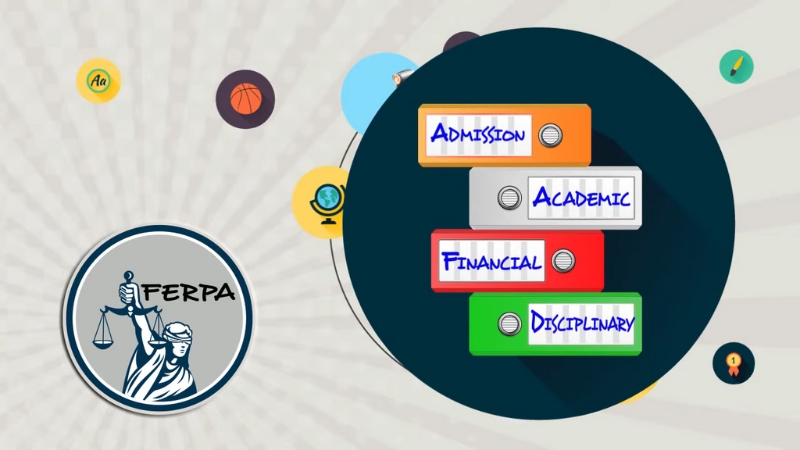
This includes academic, disciplinary, and administrative records, regardless of format. Paper files, digital databases, emails, scanned documents, and audio recordings can all be education records if they meet the criteria.
However, not everything a school creates about a student falls under FERPA. Certain records are explicitly excluded, which often causes confusion.
Records Covered by FERPA
| Record Type | FERPA Coverage |
| Transcripts and grades | Yes |
| Report cards and progress reports | Yes |
| Disciplinary records | Yes |
| Attendance records | Yes |
| Advising notes kept in official systems | Yes |
| Financial aid records | Yes |
| Emails maintained by the institution | Yes, if student-related |
Records That Are Not Covered
FERPA does not apply to:
- Sole possession notes kept only by a teacher and not shared
- Law enforcement records created by school police units
- Medical or counseling records used solely for treatment
- Employment records unrelated to student status
- Peer-graded assignments before they are collected and recorded
These exclusions matter because requests for access are often denied, not due to secrecy, but because the material is not legally an education record.
What Parents and Students Can Request

Right to Inspect and Review Records
FERPA gives eligible individuals the right to inspect and review their education records. Schools must comply within a reasonable time, not exceeding 45 days from the request.
Schools may require requests in writing and may verify identity. They must provide access, but are not always required to provide copies unless failure to do so would effectively deny access.
Right to Request Corrections
If a student or parent believes a record is inaccurate, misleading, or violates privacy, they may request an amendment. Schools must consider the request but are not required to agree.
If the school denies the amendment, FERPA requires that the requester be offered a formal hearing. If the decision remains unchanged, the requester has the right to place a written statement of disagreement in the student’s file.
FERPA Request Rights
| Right | What It Allows |
| Inspect records | View education records held by the school |
| Request copies | Obtain copies when access would otherwise be denied |
| Request correction | Challenge inaccurate or misleading records |
| Add statement | Attach disagreement to disputed records |
What Schools Can Share Without Consent
View this post on Instagram
FERPA is a privacy law, but it allows specific exceptions where schools may disclose information without consent.
One common category is directory information, which may include a student’s name, enrollment status, major, and participation in activities. Schools must define directory information publicly and allow students to opt out.
Other permitted disclosures include:
- School officials with legitimate educational interest
- Other schools where the student seeks to enroll
- Financial aid administrators
- Accrediting organizations
- Health and safety emergencies
- Judicial orders or subpoenas
Each exception has conditions, and misuse can still violate FERPA.
Common FERPA Disclosure Exceptions
| Disclosure Situation | Consent Required |
| Directory information | No, unless opted out |
| Transfer to another school | No |
| Health or safety emergency | No |
| Parent of a dependent college student | Sometimes |
| Law enforcement subpoena | No |
Special Case: Parents of College Students
Parents often assume that paying tuition or claiming a student as a dependent grants automatic access. FERPA does not work that way.
A college may disclose records to parents if the student is claimed as a dependent for federal tax purposes, but this is discretionary, not mandatory. Many institutions still require student consent as a matter of policy.
Grades, disciplinary actions, and academic standing typically remain private unless one of the narrow exceptions applies.
How to Make a FERPA Request Properly
A FERPA request should be specific, factual, and limited to education records. Overly broad or vague requests often delay processing.
Requests usually include:
- Student name and ID
- Specific records requested
- Preferred method of access
- Proof of identity or relationship
Schools are allowed to redact information relating to other students before granting access.
Practical FERPA Request Timeline
| Step | Typical Timeframe |
| Request submitted | Day 0 |
| School acknowledgment | 1–2 weeks |
| Records review provided | Within 45 days |
| Amendment decision | Varies |
| Hearing if disputed | Scheduled by school |
Common FERPA Misunderstandings
FERPA does not guarantee:
- Immediate access
- Unlimited copies of records
- Access to internal opinions or draft notes
- Parental access to adult student records by default
- Deletion of records simply because they are unfavorable
It is a procedural rights law, not a tool for controlling school documentation.
Enforcement and Complaints
@specialeducationboss Know your rights! FERPA gives parents full access to their child’s educational records—whether by viewing or requesting copies. #FERPA #EducationRights #ParentAdvocacy #StudentRecords #KnowYourRights #SpecialEducation #IEPRights ♬ original sound – “The Epic IEP”
If a student or parent believes a school has violated FERPA, they may file a complaint with the U.S. Department of Education. Complaints must generally be filed within 180 days of the alleged violation.
FERPA does not provide a private right of action. Individuals cannot sue schools directly under FERPA, but federal enforcement can require corrective action.
Final Perspective
FERPA is often described as a student privacy law, but in practice, it is a records governance framework. It defines who controls access, when disclosure is allowed, and how disputes are handled.
Parents and students who understand its scope tend to get results efficiently. Those who assume it grants total transparency usually encounter resistance, not because schools are hiding information, but because the law itself sets clear boundaries.